Choosing an Aluminum Residential Door for a home involves more than comparing catalog photos. A clean frame may look similar across brands, yet profile depth, corner joints, seals, and hardware can affect everyday performance. China has many door manufacturers, from export-focused factories to companies serving local projects. Their products and capabilities are not identical.
This guide introduces notable Chinese manufacturers and explains what buyers can compare. Useful checks include available frame systems, glass options, surface finishes, customization, production experience, and after-sales support. Ask for technical specifications, clear product photos, and details about quality checks. Small details matter. A sample corner, for example, can reveal how neatly the frame is assembled and finished.
“Top” is not a fixed ranking. The right supplier depends on the project’s climate, opening sizes, design requirements, budget, and delivery expectations. A manufacturer with an extensive catalog may not be the best fit for a small custom order. Likewise, a polished website is not proof of consistent production. Verify claims directly, and confirm that the quoted configuration matches the drawings and written specifications. This overview offers a starting point, not a substitute for careful supplier evaluation. Some details can be easy to miss, even for experienced buyers.
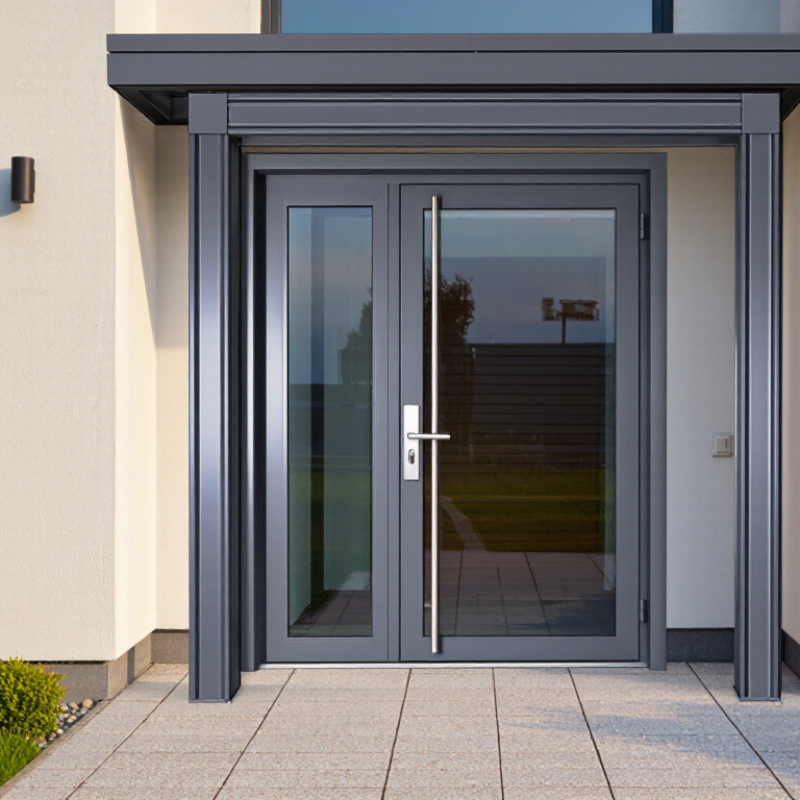
An aluminum residential door is a complete assembly: an aluminum frame and sash, infill panels or glass, seals, hinges, and locking hardware. It is used at main entrances, patios, balconies, and side or utility entrances. The frame resists moisture and needs little routine upkeep. It can also support slim sightlines, useful when a home needs daylight without a bulky frame. Details matter. Thermal breaks separate the frame’s inner and outer metal sections, while weatherstripping helps limit drafts and water entry. Neither feature guarantees good performance; installation and glazing matter too.
The International Energy Agency’s Buildings report states that buildings accounted for about 30% of global final energy consumption in 2022. That figure covers buildings broadly, not doors specifically, but it underscores why a door’s seals, glazing, and fit deserve attention. For aluminum’s material footprint, the International Aluminium Institute reports that recycling aluminum uses about 5% of the energy required to produce primary aluminum. This is a material-level comparison, not a promise that any finished door contains recycled content. Ask for documented thermal-performance and recycled-content figures. A sleek frame can still feel cold near the handle in winter. That detail is easy to overlook.
Aluminum residential doors are used for entrances, interior access, balconies, and patios. The chart shows indicative opening widths commonly used in residential layouts; actual dimensions vary with building codes, design requirements, and manufacturer specifications.
China’s aluminum residential door industry is organized as a regional supply chain, not a single national production system. Upstream, aluminum producers and profile extruders supply frames, sashes, and thermal-break sections. The National Bureau of Statistics reported 41.594 million tonnes of primary aluminum output in 2023. This indicates the scale of the material base, not the size of the door market. Downstream, factories range from standardized system manufacturers to small custom fabricators, followed by dealers and local installers. Their capabilities can differ sharply.
Product performance depends on more than the aluminum profile. Fabricators select glass, seals, hardware, and drainage details, then assemble and test the finished unit. China’s GB/T 8478-2020 standard covers aluminum alloy doors and windows, offering a shared technical reference. Still, a standard cannot confirm how carefully a specific factory controls assembly or installation. One weak point in industry comparisons is treating every supplier as equally integrated; many outsource key components.
Tips: Ask for section drawings, glass specifications, and documented test results for the exact door configuration. Check corner joints and weather seals on a physical sample. A neat showroom finish helps, but it is not proof of long-term performance.
Manufacturers recognized for residential aluminum doors are best judged by documented performance, not polished catalogues. Look for suppliers that publish test results for air leakage, water penetration, wind resistance, thermal insulation, and hardware cycles. In China, GB/T 8478-2020 provides a relevant framework for aluminum alloy doors and windows. Ask whether the tested configuration matches the quoted design; glass, seals, frame depth, and installation can change results.
The stakes are practical. The 2024 Global Status Report for Buildings and Construction, published by UNEP and the Global Alliance for Buildings and Construction, estimates that buildings account for about 32% of global energy demand and 34% of energy-related and process-related CO₂ emissions. That broad context makes thermal performance worth checking, but it does not rank door makers. Reliable candidates also provide traceable material specifications, consistent production records, clear warranty terms, and references for comparable homes. One weak point: a good factory test cannot guarantee a good installation.
Tips: Request the full test report, not just a performance label. Compare the tested door size and glass build with your order, then inspect corner joints, drainage paths, and seals on a sample. Ask for recent project references. Take time here.
Rather than presenting an unverifiable company ranking, this table summarizes the product evidence buyers can use to identify capable residential aluminum door manufacturers. Performance depends on the tested door configuration, dimensions, glazing, hardware, and installation.
| Evaluation Dimension | What to Look For | Useful Evidence or Reference | Why It Matters |
|---|---|---|---|
| Product range | Residential hinged, sliding, folding, and entry-door options, with configurations suited to the intended opening and use. | Product drawings, configuration schedules, material specifications, and installation details for the exact model. | A broad range is useful only when the supplier can document the construction and performance of each configuration. |
| Product standards and testing | Test reports for the complete door assembly, rather than general claims about aluminum profiles or individual components. | Relevant references may include China’s GB/T 8478 for aluminum alloy doors and windows, or EN 14351-1 for applicable external pedestrian doorsets in European markets. | Standards and test scope help buyers check whether reported results apply to the product and destination market. |
| Air leakage and water resistance | Documented air-infiltration and water-penetration results for a stated door size and configuration. | Reports may use methods such as ASTM E283 for air leakage and ASTM E331 for water penetration, where applicable to the project. | Seals, drainage paths, fabrication quality, and installation all affect resistance to drafts and water entry. |
| Wind-load performance | Structural test results or engineering calculations matched to the project’s opening size and design loads. | Ask for the test method, specimen dimensions, pressure levels, and any stated deflection limits. | Results from a smaller or differently constructed door may not represent a larger project unit. |
| Thermal performance | Clear information on frame construction, thermal breaks, glazing, weather seals, and whole-door thermal performance. | Request the reported U-factor or U-value, its units, and whether it applies to the glass, frame, or complete door. | Thermal performance depends on the combined frame-and-glass design; a glazing value alone does not describe the whole door. |
| Aluminum profiles and finish | Specified alloy and profile details, coating type, color options, and documented finish requirements. | Review profile drawings, coating specifications, and any relevant finish inspection or test documentation. | These details help assess durability, appearance, and suitability for the intended exposure and maintenance conditions. |
| Hardware and security | Documented hinge, lock, handle, roller, and multipoint-lock options compatible with the selected door configuration. | Request hardware specifications, load or cycle-test information where available, and details of the locking arrangement. | Hardware affects operation, security, serviceability, and the long-term performance of moving door panels. |
| Quality management and traceability | Defined inspection procedures, production records, and a process for identifying materials and finished orders. | An ISO 9001 certificate can indicate a quality-management system; it does not, by itself, certify a door’s performance. | Traceability and documented inspections make it easier to address production variation or defects. |
| Customization and project support | Ability to confirm dimensions, opening direction, glazing, finishes, packing, and installation requirements before production. | Look for approved shop drawings, written order specifications, and a clear process for checking measurements. | Accurate coordination reduces the risk of sizing, configuration, and installation problems. |
| Warranty and after-sales service | Written coverage terms for the door, finish, glass, and hardware, plus a defined process for replacement parts or claims. | Check coverage period, exclusions, maintenance requirements, and the party responsible for service. | Clear terms help buyers compare support arrangements without relying on broad, unqualified warranty claims. |
Note: Standards, certification requirements, and test methods vary by destination market. Verify the current requirements with the relevant authority or project professional, and request reports for the exact door specification being purchased.
Chinese aluminum residential door manufacturers differ in more than price. Their product ranges may include sliding, hinged, and folding doors, with options for frame depth, glazing, hardware, and surface finishes. Compare these details against your project’s climate and opening dimensions. A slim frame looks clean, but it may not suit every span or glass weight.
Manufacturing capability matters too. Ask how profiles are cut, joined, sealed, and inspected. Request drawings, material specifications, and test records for air and water performance. Details matter. A polished sample cannot prove every production batch matches it. Communication also affects results: clear replies about tolerances and installation requirements are useful evidence of technical understanding.
Tips: Send the same window and door schedule to each supplier. Compare frame sections, glass options, hardware, finish samples, lead times, and inspection procedures side by side. Ask who checks dimensions before production and how damage is handled. Still, gaps happen; confirm critical measurements locally before approving fabrication.
When comparing aluminum residential door manufacturers in China, buyers should look beyond price and catalog photos. Ask for the profile depth, wall thickness, alloy specification, and available thermal-break options. These details affect strength, insulation, and how the door feels in daily use. Check the corner joints. A sample should open smoothly, sit square, and show consistent coating around edges and hardware cutouts.
Request test reports for the exact door configuration being quoted, not a similar model. Glass type, seals, frame size, and hardware can change performance. A polished catalog proves little. Ask how the factory checks dimensions, finish thickness, and operation before packing. Photos or records from recent inspections can help, though they are not a substitute for independent verification. Details matter.
Communication and after-sales support also deserve careful review. Confirm who handles drawings, packaging, replacement parts, and technical questions, and agree on response times in writing. Ask for a production sample or detailed mock-up before approving a large order. Then compare it with the approved drawings. A factory may promise broad customization, but unusual colors or sizes can affect lead times and cost. I would not assume the cheapest quote is the best value; sometimes I still miss a hidden exclusion. Check what is included, especially glazing, locks, delivery packaging, and installation guidance.
Look for full test reports covering air leakage, water penetration, wind resistance, insulation, and hardware cycles. A polished catalogue is not proof.
GB/T 8478-2020 provides a framework for aluminum alloy doors and windows. Check that the tested design matches your order.
Glass, seals, frame depth, and door size can change performance. Compare these details with the quoted design.
Check the corner joints, drainage paths, seals, and coating edges. Open and close the door to see if it moves smoothly. Small details count.
Request profile depth, wall thickness, alloy details, and thermal-break options. These affect strength, insulation, and everyday operation.
Ask how dimensions, finish thickness, and operation are checked before packing. Recent inspection photos or records can help, but they are not independent proof.
Confirm responsibility for drawings, packaging, replacement parts, and technical questions. Put response times in writing. Then compare a sample with approved drawings.
Check what each price includes, such as glazing, locks, packaging, and installation guidance. Confirm warranty terms and project references. I may still miss a hidden exclusion, so ask directly.
Aluminum Residential Door systems are valued for their light weight, durability, and adaptability to different home designs. They can be used for main entrances, patios, balconies, and interior spaces, with options that balance security, weather resistance, appearance, and ease of maintenance. China’s industry includes manufacturers with varied production scales and areas of focus, from standard residential models to customized designs and coordinated door-and-window solutions.
When comparing manufacturers, buyers should look beyond appearance and price. Consider material quality, frame and hardware options, insulation and sealing performance, available finishes, customization capabilities, production consistency, and after-sales support. Clear communication about measurements, installation requirements, delivery schedules, and warranty terms can also help avoid problems. A well-matched supplier should be able to explain how its products suit the home’s climate, layout, and intended use, making it easier to choose a reliable door solution.

Steelwar