Finding a dependable China Aluminium Entrance Door supplier requires more than comparing catalogue prices. A professional buyer should examine factory capability, product testing, material quality, and communication habits. Aluminium profiles should have clear alloy and temper details. Powder coating should be consistent, without pinholes, color patches, or rough edges. Ask for section drawings, thermal-performance data, water-tightness results, and hardware specifications before requesting a final quotation.
Fenestration consultant John Weatherley once said, “The best door is not the cheapest door; it is the door that performs consistently after installation.” This practical view matters when evaluating Chinese manufacturers. A serious supplier should explain its profile system, glass options, drainage design, sealing method, and production tolerances. Factory photographs help, but an independent audit or live video inspection provides stronger evidence. Request recent project references, sample corners, packaging images, and a written warranty. Small details reveal experience. Check the threshold.
A useful comparison should include more than the unit price. Calculate shipping volume, protective packaging, installation accessories, replacement parts, and possible rework. Confirm whether the supplier can meet your market’s applicable building and safety requirements. Some suppliers display impressive showroom doors but outsource critical components. That is a warning sign. Others respond quickly yet provide vague technical answers. Also risky.
The right partner combines stable production, documented quality control, responsive engineering support, and honest limitations. You may still find imperfections during sampling. That is normal, and worth discussing openly. A careful selection process gives your Aluminium Entrance Door project a stronger chance of achieving durability, appearance, and dependable long-term performance.
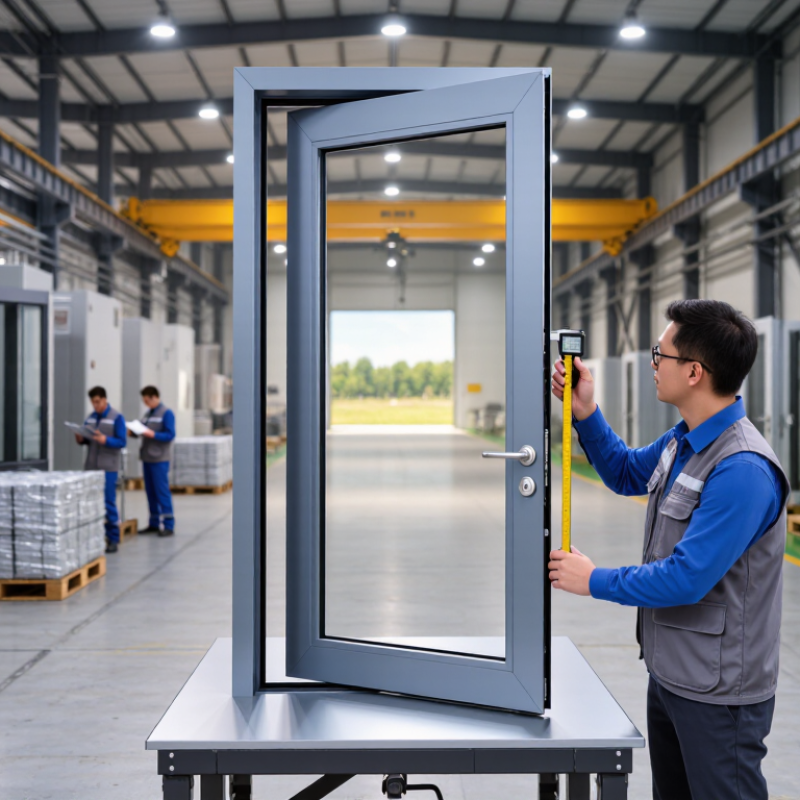
Before contacting China aluminium entrance door suppliers, define the door’s working conditions. Record the opening width, height, wall thickness, and threshold level. Measure twice. A small error can affect installation and final cost.
Decide whether the entrance faces heavy rain, strong sunlight, coastal air, or frequent public use. These conditions influence aluminium thickness, surface treatment, drainage, seals, and hardware selection. Specify the opening direction, single or double leaf design, glass type, colour, and security requirements. For busy buildings, request tested hinges, reliable locks, and a replaceable weather seal. Small details matter.
I once saw a project delayed because the specified frame depth did not match the finished wall. The drawing looked correct, but the site measurement was incomplete. Ask suppliers for section drawings, tolerance data, finish samples, and installation guidance. Request evidence of relevant testing and destination-market compliance, rather than accepting general quality claims. Include packaging requirements, delivery terms, inspection stages, and spare hardware in the inquiry. Leave room for revision. Your first specification may be too ambitious for the budget, or too vague for accurate production. A simple approved sample or mock-up can reveal awkward handle positions, visible gaps, and colour differences before mass manufacturing begins.
| Requirement Category | Specification Dimension | Recommended Requirement or Reference Value | Why It Matters | Supplier Verification Method |
|---|---|---|---|---|
| Project Application | Building type | Residential entrance, apartment building, villa, office, hotel, retail, or institutional project | Different buildings require different levels of security, thermal insulation, durability, and traffic resistance. | Provide the supplier with project drawings, photographs, usage conditions, and expected daily traffic. |
| Door Configuration | Opening style | Single swing, double swing, pivot, or automatic entrance door | The opening style affects hardware selection, clear opening width, structural support, and installation cost. | Request a configuration drawing showing the opening direction, hinge side, active leaf, and inactive leaf. |
| Door Size | Overall opening dimensions | Record finished opening width, height, wall thickness, threshold height, and required clear passage. Take measurements in millimetres. | Accurate dimensions reduce fitting problems and prevent costly site modifications. | Ask for an approved shop drawing based on at least three width and three height measurements at the site. |
| Door Leaf | Leaf thickness | Common insulated aluminium door leaves are approximately 50–100 mm thick, depending on the frame system and core construction. | Thickness influences thermal performance, rigidity, acoustic performance, and hardware compatibility. | Confirm the section drawing, internal reinforcement, insulation core, and finished leaf thickness. |
| Aluminium Material | Aluminium alloy and temper | Use a suitable architectural aluminium alloy and temper specified by the system designer; common extruded architectural grades include 6063-T5 or 6063-T6. | Alloy and temper affect strength, extrusion quality, surface finish, and dimensional stability. | Request the material declaration, mill certificate, or third-party material test report for the supplied batch. |
| Profile Design | Thermal break | For conditioned buildings, specify thermally broken profiles with polyamide thermal barriers, commonly around 20–34 mm depending on the system. | A thermal break reduces heat transfer and helps limit interior surface condensation. | Check the cross-section drawing, thermal-barrier material, barrier width, and frame Uf value calculation. |
| Thermal Performance | Whole-door U-value | Set a project target according to the local energy code; a practical high-performance target is approximately 1.0–2.0 W/(m²·K), subject to door size, glazing, and climate. | Lower U-values generally indicate lower heat transfer through the complete door assembly. | Request a calculated or tested whole-door U-value rather than only the aluminium profile U-value. |
| Air Tightness | Air leakage | Specify the required performance class under the applicable standard, such as EN 12207, or the equivalent local code. | Good air tightness improves comfort, energy efficiency, and resistance to dust and drafts. | Request an air-permeability test report for a representative door size and configuration. |
| Water Resistance | Watertightness | Specify a project-appropriate class under EN 12208 or the applicable regional standard; exposed entrances generally require a higher class than sheltered entrances. | Water resistance is especially important for exterior doors exposed to wind-driven rain. | Review the test pressure, drainage design, threshold detail, and test configuration. |
| Wind Resistance | Wind load | Calculate the required design pressure from local wind speed, building height, exposure, and door size. Do not select a class by appearance alone. | Large or tall entrance doors may experience significant deflection under wind pressure. | Request structural calculations or a test report covering the specified width, height, and mullion arrangement. |
| Glazing | Glass construction | Choose laminated, tempered, insulated, or laminated-insulated glass according to safety, thermal, acoustic, and security requirements. | Entrance glazing is vulnerable to impact and may require safety glazing in accordance with local regulations. | Confirm glass thickness, make-up, safety classification, spacer type, edge deletion, and certification. |
| Glazing Safety | Safety glass location | Use safety glazing in doors and adjacent hazardous locations where required by the applicable building code. | Safety glazing is designed to reduce injury risk when the glass is broken or impacted. | Request compliance evidence such as impact-test documentation and permanent safety markings where required. |
| Security | Locking system | Specify single-point or multipoint locking, cylinder type, latch configuration, and access-control preparation. | The locking system affects resistance to forced entry and compatibility with building access systems. | Check the lock body, strike plate, cylinder dimensions, fixing method, and replacement availability. |
| Security | Security performance | For higher-risk locations, define a target class under a recognized standard such as EN 1627, where applicable. | A documented security class is more reliable than general descriptions such as “high security.” | Request a valid test report matching the complete door assembly, including frame, lock, hinges, glass, and fixing method. |
| Hardware | Hinges and door closers | Select concealed or surface-mounted hinges and a closer rated for the door leaf weight, width, and expected cycle frequency. | Undersized hardware can cause sagging, poor latching, premature wear, and difficult operation. | Confirm hardware load rating, adjustment range, cycle testing, corrosion resistance, and spare-parts policy. |
| Accessibility | Clear opening and threshold | Define the required clear width, opening force, threshold height, and maximum permissible threshold profile according to the local accessibility code. | Accessible entrances must be usable by people with mobility limitations and should support smooth movement. | Review the clear-opening measurement, threshold detail, door closer force, and accessibility compliance documentation. |
| Surface Finish | Finish type | Choose powder coating, anodizing, or another approved architectural finish according to exposure, appearance, and maintenance requirements. | Finish selection affects colour stability, corrosion resistance, scratch resistance, and service life. | Request finish samples, coating thickness data, colour tolerance requirements, and relevant durability certificates. |
| Coastal Exposure | Corrosion protection | For coastal or high-humidity environments, specify a corrosion-resistant finish system and compatible stainless-steel or protected hardware. | Salt spray and moisture can accelerate corrosion at profiles, fasteners, hinges, locks, and drainage points. | Ask for the corrosion-resistance test method, exposure classification, hardware material, and maintenance instructions. |
| Acoustic Performance | Sound reduction | Set a target weighted sound reduction index according to the project; approximately 30–40 dB may be suitable for many standard external applications, subject to design. | Acoustic performance depends on the complete assembly, including glass, seals, frame, threshold, and installation joints. | Request a laboratory test report for the complete door configuration, not only the glass or profile. |
| Fire and Smoke | Fire-rated requirement | If the door is located on a required fire or smoke compartment line, specify the required rating and hardware package before production. | Fire-rated assemblies require tested combinations of leaf, frame, glass, seals, hardware, and installation details. | Request certification from an accredited laboratory for the exact tested configuration and installation method. |
| Drainage | Threshold and water drainage | Define whether the threshold is recessed, low-profile, thermally broken, accessible, or weather-rated, and require dedicated drainage paths. | Correct drainage reduces water accumulation and protects the interior floor finish. | Review threshold sections, weep-hole locations, sill pan details, sealant joints, and site interface drawings. |
| Installation | Fixing and perimeter joint | Specify wall type, fixing spacing, anchor material, backer rod, sealant type, and recommended perimeter joint width. | Installation quality can affect air, water, wind, thermal, and security performance as much as the door itself. | Require a method statement, installation manual, approved anchor details, and a site quality checklist. |
| Quality Control | Factory inspection | Inspect dimensions, diagonals, profile joints, glass installation, hardware operation, surface finish, seals, and packaging before shipment. | Pre-shipment inspection can identify defects before the doors reach the project site. | Use an inspection checklist with measurable acceptance criteria and photographic records. |
| Documentation | Technical file | Require shop drawings, section details, bill of materials, test reports, finish data, installation instructions, maintenance instructions, and warranty terms. | Complete documentation supports approval, installation, future maintenance, and dispute prevention. | Make document submission and approval a condition before mass production. |
| Packaging | Export protection | Use corner protection, moisture-resistant wrapping, separated glass protection, impact-resistant crates, and clear package labels. | Aluminium profiles, finished surfaces, glass, and hardware can be damaged during long-distance transportation. | Approve the packing method, package dimensions, gross weight, handling marks, and loading photographs. |
| Commercial Terms | Supplier quotation comparison | Compare the same scope: door size, profile system, glass, hardware, finish, packaging, testing, delivery terms, installation support, and warranty. | A lower initial price may exclude important components or performance requirements. | Use a standardized request-for-quotation sheet and require itemized pricing for every component. |
| Supplier Selection | Production capability | Evaluate design engineering, extrusion or sourcing control, fabrication equipment, glazing capacity, testing resources, quality system, and export experience. | A capable supplier should be able to reproduce approved samples consistently at project volume. | Request factory audit evidence, production flow charts, quality-control records, sample approvals, and reference project documentation without relying on brand claims. |
Compare factory experience, production capacity, export history, and documentation. Request identical specifications from at least five suppliers. A low price may hide thin profiles or weak hardware. Leave room for doubt.
Ask for alloy grade, profile thickness, thermal-break construction, glass details, and coating standards. Confirm whether test reports match the exact door model. Photos help, but samples reveal more.
Request a full-size corner sample, not only a small finish panel. Check frame joints, hinge alignment, lock movement, gaskets, and coating consistency. Inspect it under direct light.
Use an independent inspection when possible. Check dimensions, random cartons, accessories, labels, welding, sealing, and packaging. Photograph every carton before loading. Small defects matter.
Specify alloy grade, wall thickness, glass type, colour code, tolerances, and inspection rights. Include packaging photos, replacement procedures, payment stages, and warranty exclusions. Verbal promises are difficult to enforce.
Require strong corner protection and moisture-resistant wrapping. Ask for moisture protection inside crates. Confirm the port, insurance responsibility, documents, and delay risks. Good logistics cannot fix careless packing.
Set a written response time, spare-parts availability, and warranty coverage. An initial reply within two business days is practical. Define exclusions clearly. Details get forgotten.
Do not trust polished presentations, certificates, or spreadsheets alone. Verify project references independently. Keep one approved sample for final comparison. I might still overlook drainage or local installation habits.
Finding the right China Aluminium Entrance Door supplier starts with clearly defining your project requirements, including door size, material grade, design, finish, thermal performance, security features, and required standards. Once your specifications are established, research the supplier market and create a shortlist based on manufacturing experience, product range, export capability, customer feedback, and communication quality. Carefully evaluate each supplier’s certifications, quality-control procedures, production equipment, factory capacity, and ability to maintain consistent standards for large or customized orders.
When comparing shortlisted suppliers, review total pricing, customization options, minimum order quantities, production lead times, payment conditions, packaging, and shipping terms rather than focusing only on the unit price. Request samples to inspect construction, surface treatment, hardware, and functionality before placing an order. A detailed contract should define technical specifications, inspection procedures, delivery responsibilities, warranty terms, and after-sales support. By verifying these factors in advance, buyers can reduce purchasing risks, improve project efficiency, and build a reliable long-term supply relationship.

 Steelwar